

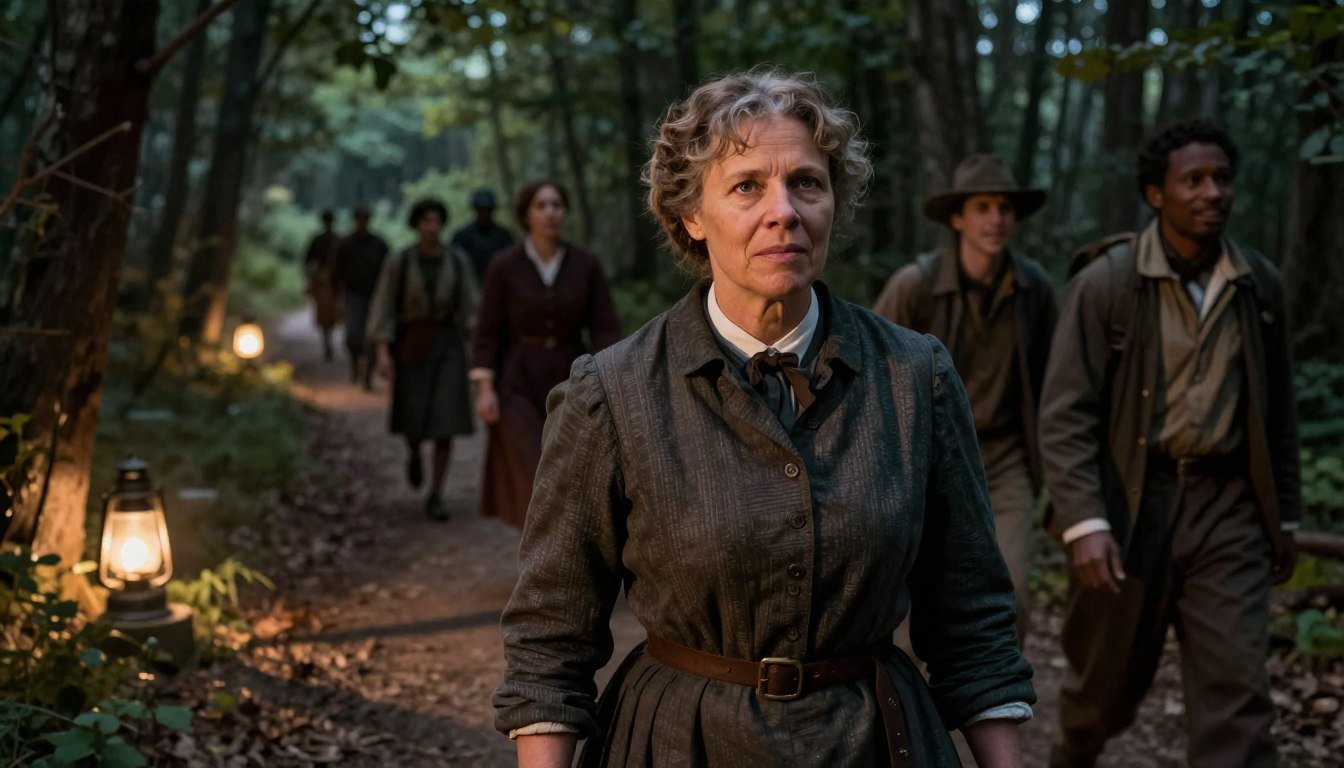
Who Was Harriet Tubman? Many brave souls fought for freedom, yet few shine as brightly as this legendary conductor. Her Harriet Tubman biography reveals a life defined by immense courage and selfless sacrifice. She risked everything to guide others toward liberty, forever changing the American landscape.

Operating through the shadows, she became a beacon of hope for those seeking escape. The Underground Railroad served as a vital network, and her leadership proved essential to its success. Every journey she led represents a triumph of the human spirit over oppression.
Exploring these events helps us appreciate the heavy price paid for equality. We invite you to discover the remarkable story of a woman whose legacy continues to inspire generations today.
Key Takeaways
- She emerged as a primary conductor for the secret network of safe houses.
- Her efforts directly led dozens of enslaved people to northern states and Canada.
- She displayed unmatched bravery by returning to dangerous territories multiple times.
- The network she utilized relied on clever codes and hidden routes for safety.
- Her life serves as a powerful testament to the fight for human rights.
who was Harriet Tubman in history
The life of Harriet Tubman is a testament to the strength and resilience of the human spirit in the face of oppression. Born into slavery around 1822 in Dorchester County, Maryland, Harriet Tubman’s early life was marked by hardship and brutality. She suffered physical and emotional abuse, which had a lasting impact on her health and well-being.
Despite the harsh conditions, Tubman’s spirit remained unbroken. She found solace in her faith and the stories of her ancestors, which instilled in her a deep desire for freedom. Her determination to escape the bonds of slavery led her to become one of the most famous conductors on the Underground Railroad, a network of secret routes and safe houses used by enslaved individuals to escape to freedom in the 19th century.
Tubman’s contributions to the abolition of slavery were significant. She not only escaped to freedom herself but also returned to the South multiple times to help lead hundreds of other enslaved individuals to freedom. Her bravery and cunning in the face of danger earned her the nickname “Moses” among abolitionists and the enslaved.
Her work on the Underground Railroad was just one aspect of her fight against slavery. During the Civil War, Tubman served as a nurse, cook, and spy for the Union Army, further cementing her legacy as a champion of freedom and equality.
Early Life and the Struggle for Freedom
Born into bondage, Harriet Tubman’s life was marked by hardship and a relentless pursuit of liberty. Her early years were spent on a plantation in Dorchester County, Maryland, where she experienced the brutal realities of slavery firsthand.
Growing Up in Bondage
Harriet Tubman was born Araminta Ross, around 1822. She was one of nine children born into slavery, and from a young age, she faced physical and emotional abuse. The harsh conditions of slavery had a profound impact on her life and shaped her future actions.
As a child, Tubman was hired out to neighboring families to work as a nursemaid and later as a field hand. This exposure to the outside world beyond her own plantation made her more aware of the vastness of the slave system and the possibilities of freedom.
The Defining Moment of Escape
The turning point in Tubman’s life came when her owner died in 1849, and she feared being sold to the Deep South. This fear prompted her to make a daring decision: she would escape to freedom in the North. The journey was fraught with danger, but Tubman’s determination was unwavering.
In the fall of 1849, Tubman made her escape, traveling at night and using the North Star as her guide. She followed the network of abolitionists and sympathetic individuals who provided her with food, shelter, and guidance.
| Year | Event | Significance |
|---|---|---|
| 1822 | Harriet Tubman born into slavery | Began life under harsh slavery conditions |
| 1849 | Owner dies; Tubman fears being sold | Prompted her decision to escape |
| 1849 | Tubman escapes to freedom | Marked the beginning of her fight against slavery |
The Courageous Conductor of the Underground Railroad
Harriet Tubman’s work as a conductor on the Underground Railroad exemplified her unrelenting spirit and commitment to the abolition of slavery. She risked her life multiple times to guide hundreds of enslaved individuals to freedom, earning her a legendary status in American history.
Her journeys were fraught with danger, as she navigated through treacherous terrain and hostile territories. The threat of capture and return to slavery was ever-present, yet Tubman persevered, driven by her determination to liberate others.
Navigating the Dangerous Routes
The Underground Railroad was not a physical railroad but a network of secret routes and safe houses. Harriet Tubman used her knowledge of the land, acquired during her own escape and subsequent trips back to the South, to guide fugitives through the treacherous terrain.
She traveled mostly at night, using the North Star as her guide, and rested during the day in safe houses or “stations.” The journey was perilous, with risks including slave catchers, harsh weather conditions, and the ever-present danger of being caught and returned to slavery.
Strategies for Evading Capture
Tubman employed various strategies to evade capture, including disguising herself and her fugitives. She used different costumes and altered her appearance to avoid detection by slave catchers.
She also carried a revolver for protection and was not afraid to use it. Her bravery and cunning were key to her success in evading capture and ensuring the safety of those she was guiding to freedom.
In addition to her physical courage, Tubman used her knowledge of the railroad’s network to keep her fugitives safe. She would often change her route and use different stations to avoid detection.
A Life Dedicated to Saving Others
With unwavering resolve, Harriet Tubman risked everything to help others escape the shackles of slavery. Her actions were not without significant personal risk, as she ventured back into the South multiple times, defying the dangers that lurked at every turn.

The Risks of Returning to the South
Returning to the South was a perilous endeavor for Harriet Tubman. She had to navigate through treacherous landscapes and avoid detection by slave catchers and their dogs. The risks were immense, but her determination to free as many enslaved individuals as possible drove her forward.
Tubman’s knowledge of the land, acquired during her time as a slave and later as a conductor on the Underground Railroad, proved invaluable. She used this knowledge to evade capture and reach those who were still enslaved.
Impact on Enslaved Families
The impact of Harriet Tubman’s actions on enslaved families was profound. By helping hundreds escape to freedom, she not only changed the lives of those individuals but also had a lasting effect on their families. The freedom she helped secure for others brought hope and a sense of possibility to those who remained.
Moreover, Tubman’s efforts contributed significantly to the abolition of slavery. Her work, along with that of other abolitionists, helped to galvanize public opinion against the injustices of slavery, bringing the issue to the forefront of national debate.
Harriet Tubman’s legacy is a testament to the power of courage and conviction. Her life’s work continues to inspire generations, serving as a powerful reminder of the impact one individual can have on the fight for freedom and equality.
Service During the Civil War
As the Civil War raged on, Harriet Tubman stepped forward to serve the Union Army in various capacities. Her experience and knowledge gained from her work on the Underground Railroad made her an invaluable asset to the Union forces.
Harriet Tubman’s contributions to the Civil War effort were multifaceted. She worked closely with the Union Army, utilizing her skills in multiple roles.
Working as a Nurse and Scout
One of Harriet Tubman’s critical roles during the Civil War was her work as a nurse and scout. She provided essential care to wounded soldiers and helped gather intelligence behind enemy lines. Her knowledge of the Southern terrain and her ability to navigate it safely were crucial to the Union Army’s operations.
- She worked in hospitals and camps, providing care and comfort to soldiers.
- Her scouting missions provided vital information about Confederate troop movements and strategies.
Her work as a nurse and scout was not without risk. She faced the ever-present danger of being captured by Confederate forces, who would have seen her as a significant threat.
The Combahee River Raid
One of the most notable military operations Harriet Tubman was involved in was the Combahee River Raid. This daring operation, conducted in June 1863, aimed to disrupt Confederate supply lines and liberate enslaved individuals in the region.
The raid was a resounding success, with Harriet Tubman guiding Union troops through the treacherous waters and terrain. The operation resulted in the liberation of over 700 enslaved people, dealing a significant blow to the Confederacy.
The Combahee River Raid stands as a testament to Harriet Tubman’s bravery and strategic thinking. It was a pivotal moment in the war and a significant milestone in her long fight against slavery.
Through her service during the Civil War, Harriet Tubman continued to demonstrate her unwavering commitment to the cause of freedom and equality. Her actions not only contributed to the Union’s war effort but also paved the way for future generations to continue the fight for human rights.
Advocacy for Women’s Suffrage and Human Rights
Harriet Tubman’s legacy extends far beyond the Civil War, as she became a pivotal figure in the women’s suffrage movement. Her fight for justice and equality didn’t end with the abolition of slavery; instead, it evolved to address the broader issues of women’s rights.
As the Civil War came to a close, Tubman continued to face personal and financial struggles. Despite these challenges, she remained committed to her mission. Her experiences during the war had reinforced her belief in the importance of equal rights for all.
Life After the War
After the war, Tubman settled in Auburn, New York, where she continued to be involved in local and national activism. She married Nelson Davis, a fellow veteran, and adopted a baby girl named Gertie. Tubman’s life after the war was marked by her ongoing fight for justice and her efforts to secure a stable future for her family.
“I had reasoned this out in my mind; there was one of two things I had a right to, liberty or death; if I could not have one, I would take the other; for no man should take me alive.” – This determination, expressed by Harriet Tubman, encapsulates her unwavering commitment to fighting for what she believed in, including women’s suffrage.

Fighting for Equality and Voting Rights
Tubman’s involvement in the women’s suffrage movement was a natural extension of her previous work. She attended meetings, participated in protests, and used her powerful personal story to advocate for change. Her activism was instrumental in galvanizing support for the women’s suffrage movement.
In 1896, Tubman became a member of the National Woman Suffrage Association, further solidifying her commitment to the cause. Her efforts, alongside those of other suffragists, paved the way for future generations of women to fight for and eventually secure the right to vote with the passage of the 19th Amendment in 1920.
“The vote is the most powerful instrument ever devised by man for breaking down injustice and destroying the stronghold of reaction.”
Tubman’s advocacy for women’s suffrage was part of a broader commitment to human rights. Her work serves as a powerful reminder of the importance of continued activism and the need to challenge injustice in all its forms.
The Enduring Legacy of a National Icon
The enduring legacy of Harriet Tubman is a powerful reminder of the struggle for freedom and human rights. Her life’s work continues to inspire and educate people about the importance of standing against injustice and fighting for equality.
Harriet Tubman’s story is not just a historical account; it is a living testament to the impact one person can have on the course of history. Her bravery and determination have become a beacon of hope for generations, demonstrating that individual actions can collectively lead to significant social change.
Honoring Her Memory Today
Today, Harriet Tubman is honored in various ways across the United States. Her image has been used in art, literature, and even currency, symbolizing her importance in American history. The U.S. Treasury Department announced plans to add her portrait to the $20 bill, a move that underscores her significance as a national icon.
Various monuments and museums dedicated to her life and work can be found in places significant to her journey, such as Maryland and Auburn, New York. These sites serve as educational hubs, providing insight into her life and the historical context in which she lived.
Lessons for Future Generations
The life of Harriet Tubman offers valuable lessons for future generations. Her unwavering commitment to the cause of freedom and equality teaches us about the importance of perseverance and moral courage. It highlights the impact that dedicated individuals can have on societal change.
One of the key lessons from Harriet Tubman’s life is the power of community and networks. Her work with the Underground Railroad demonstrates how collective action and support can achieve remarkable outcomes. This lesson is particularly relevant today, as communities continue to come together to address social injustices.
| Aspect of Legacy | Impact | Relevance Today |
|---|---|---|
| Abolition of Slavery | Contributed significantly to the freedom of hundreds of enslaved individuals | Continues to inspire movements against modern slavery and human trafficking |
| Women’s Suffrage | Paved the way for future generations of women to fight for voting rights | Remains a powerful symbol of the fight for gender equality |
| Civil Rights Movement | Her courage and determination inspired others to join the fight for civil rights | Continues to motivate contemporary civil rights activism |
Harriet Tubman’s legacy is a testament to the enduring power of courage, resilience, and the human spirit. As we reflect on her life and achievements, we are reminded of the ongoing struggle for justice and equality, and the importance of continuing her work towards a more just society.
Conclusion
Harriet Tubman’s life is a testament to courage and resilience in the face of overwhelming adversity. Understanding who was Harriet Tubman in history reveals a complex figure who played a pivotal role in the fight against slavery through her work with the Underground Railroad.
Her bravery and determination not only freed hundreds of enslaved individuals but also inspired a nation to reevaluate its stance on freedom and equality. The legacy of Harriet Tubman continues to be felt today, serving as a powerful reminder of the impact one person can have on the course of history.
As a symbol of resistance and freedom, Harriet Tubman’s story remains an essential part of American history, encouraging future generations to stand against injustice and fight for human rights.
FAQ
Who exactly was Harriet Tubman and why is she so significant in American history?
What was the defining moment that led to her escape from bondage?
How did the Underground Railroad actually function for Harriet Tubman?
What specific risks did she face while returning to the South?
What was Harriet Tubman’s role in the Combahee River Raid?
How did she contribute to the fight for women’s voting rights?
Where can people go to honor the legacy of Harriet Tubman today?
