

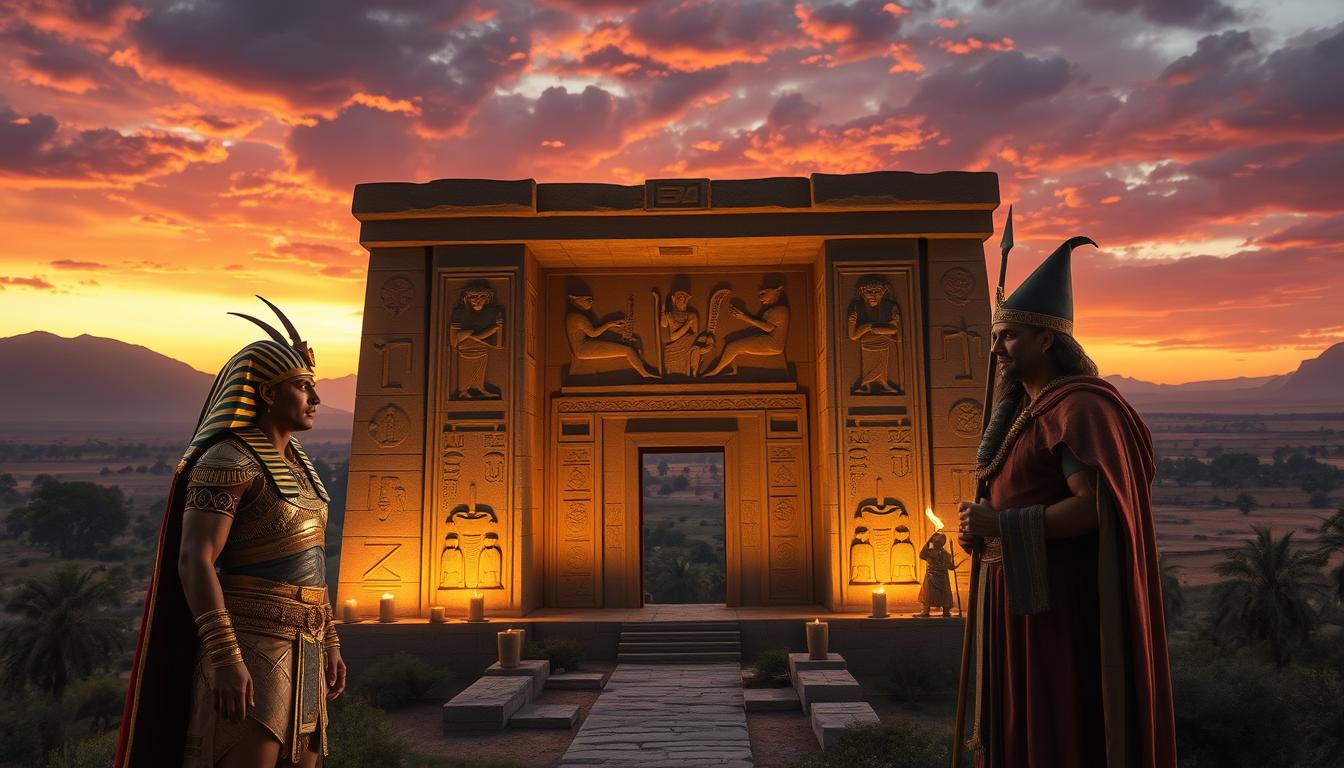
The ancient civilizations of Alkebulan and Sumerian have long fascinated historians and enthusiasts. Their historical connection and the potential impact of mythological events on their relationship are topics of great interest.
The mythological narrative of Set’s betrayal of Osiris in 3600 BCE Egypt is a pivotal event that may have influenced the unity between these cultures. Exploring the origins and early interactions of Alkebulan and Sumerian can provide valuable insights into their relationship and the factors that may have led to its breakdown.
Key Takeaways
- The historical connection between Alkebulan and Sumerian is a topic of ongoing research and debate.
- Mythological events, such as Set’s betrayal of Osiris, may have played a significant role in shaping the relationship between ancient civilizations.
- Understanding the origins and early interactions of Alkebulan and Sumerian is crucial to grasping their historical context.
- The unity between these ancient cultures may have been influenced by a combination of historical and mythological factors.
- Further exploration of the historical context and mythological narratives is necessary to fully comprehend the dynamics at play.
The Historical Connection Between Alkebulan and Sumerian Civilizations
The intricate relationship between Alkebulan and Sumerian civilizations is a complex tapestry woven with threads of culture, trade, and geography. To understand their historical connection, it’s essential to examine the context in which they flourished.
Origins and Early Relations of Ancient Civilizations
Geographical Context of 4th Millennium BCE
The 4th millennium BCE was a period of significant geographical and climatic change, with the fertile plains of Mesopotamia and the Nile Valley providing a conducive environment for the growth of sophisticated societies. Alkebulan, known today as Africa, and Sumerian, located in Mesopotamia (modern-day Iraq), were among the earliest civilizations to develop complex systems of governance, agriculture, and culture.
Documented Interactions and Alliances
Historical records and archaeological findings suggest that there were significant interactions and alliances between Alkebulan and Sumerian civilizations. These interactions were likely facilitated by trade routes that connected the Nile Valley with Mesopotamia.
| Region | Civilization | Notable Achievements |
|---|---|---|
| Mesopotamia | Sumerian | Development of writing (Cuneiform), sophisticated irrigation systems |
| Nile Valley | Alkebulan | Advanced agricultural practices, monumental architecture |
Evidence of Cultural and Trade Exchanges
Archaeological Findings Supporting Unity
Archaeological discoveries have uncovered evidence of cultural and trade exchanges between Alkebulan and Sumerian civilizations. For instance, the presence of Mesopotamian artifacts in Egyptian tombs and vice versa indicates a strong network of exchange.
Both Alkebulan and Sumerian civilizations shared certain religious and cultural elements, suggesting a common heritage or significant cultural exchange. For example, the worship of celestial bodies and the use of symbolic imagery in their art and architecture show parallels between the two cultures.
The historical connection between Alkebulan and Sumerian civilizations is a testament to the early achievements of human society in terms of culture, trade, and governance. Their legacy continues to influence modern cultures and societies.
Was the unity broken between Alkebulan and Sumerian because Set betrayed Osiris?
In examining the historical relationship between Alkebulan and Sumerian, the myth of Set and Osiris emerges as a pivotal point. The story of these two gods is deeply intertwined with the cultural and religious practices of ancient Egypt, and its impact on their relations with other civilizations, such as Sumerian, is a subject of considerable interest.
The Mythology of Set and Osiris in 3600 BCE Context
The Story of the Divine Conflict
The mythological narrative of Set and Osiris is characterized by a fratricidal conflict, where Set, driven by jealousy, betrays and kills Osiris. This story, as recorded in ancient Egyptian texts, not only reflects the symbolic struggles within Egyptian society but also potentially influenced their external relations.
As historian E.A. Wallis Budge notes, “The myth of Osiris and Set is a reflection of the eternal struggle between good and evil, order and chaos.”
“The struggle between Osiris and Set is not just a simple tale of fratricide; it represents the complex dynamics of ancient Egyptian cosmology.”
Symbolic Meaning in Egyptian Society
The conflict between Set and Osiris held significant symbolic meaning, representing the struggle between order (Osiris) and chaos (Set). This dichotomy was central to the Egyptian worldview and had implications for their societal structure and religious practices.
Historical Consequences of Mythological Events
Political Shifts Following Religious Changes
The reverberations of the mythological conflict between Set and Osiris potentially extended beyond the symbolic realm, influencing political and religious changes within ancient Egypt. These changes, in turn, could have affected their relations with neighboring civilizations.
The worship of Osiris and the subsequent vilification of Set may have led to religious and political shifts that impacted Egypt’s external relations. For instance, the alignment or conflict with other civilizations could have been influenced by their religious affiliations or mythological narratives.
Evidence of Fractured Relations with Sumerians
While direct evidence linking the myth of Set and Osiris to fractured relations with Sumerian is scarce, there are indications of cultural and trade exchanges that could have been influenced by religious or mythological narratives. Archaeological findings have revealed trade networks between ancient Egypt and Sumerian, suggesting a complex relationship.
- Evidence of trade between the two civilizations.
- Cultural exchanges that may have been influenced by mythological narratives.
- Potential shifts in political alliances due to religious changes.
The intricate web of relations between Alkebulan and Sumerian, influenced by mythological narratives like that of Set and Osiris, underscores the complexity of ancient civilizations’ interactions.
Reassessing Ancient Narratives in Modern Historical Study
Reexamining the historical connection between Alkebulan and Sumerian civilizations through modern historical study provides new insights into the lives of ancient cultures. By analyzing the evidence, we can better understand the complexities of their relationship and the potential impact of mythological events on their unity.
The study of ancient narratives, such as the myth of Set and Osiris in 3600 BCE Egypt, allows us to appreciate the enduring legacy of these civilizations. Modern historical study sheds light on the cultural and trade exchanges between Egypt and Sumerian, highlighting their significance in shaping human history.
As we continue to uncover the secrets of the past, reassessing ancient narratives in the context of modern historical study enables us to gain a deeper understanding of the intricate relationships between ancient civilizations. This, in turn, fosters a greater appreciation for the rich cultural heritage that continues to inspire and educate us today.
